Markets: United States and Canada, two separate sites
Launch: November 2026
Stack: Sanity CMS, Next . js, Vercel Integrations: OLO, Punchh, Paytronix, Givex, Guest XM, Google Maps, OneTrust , GA4 and GTM
Overview
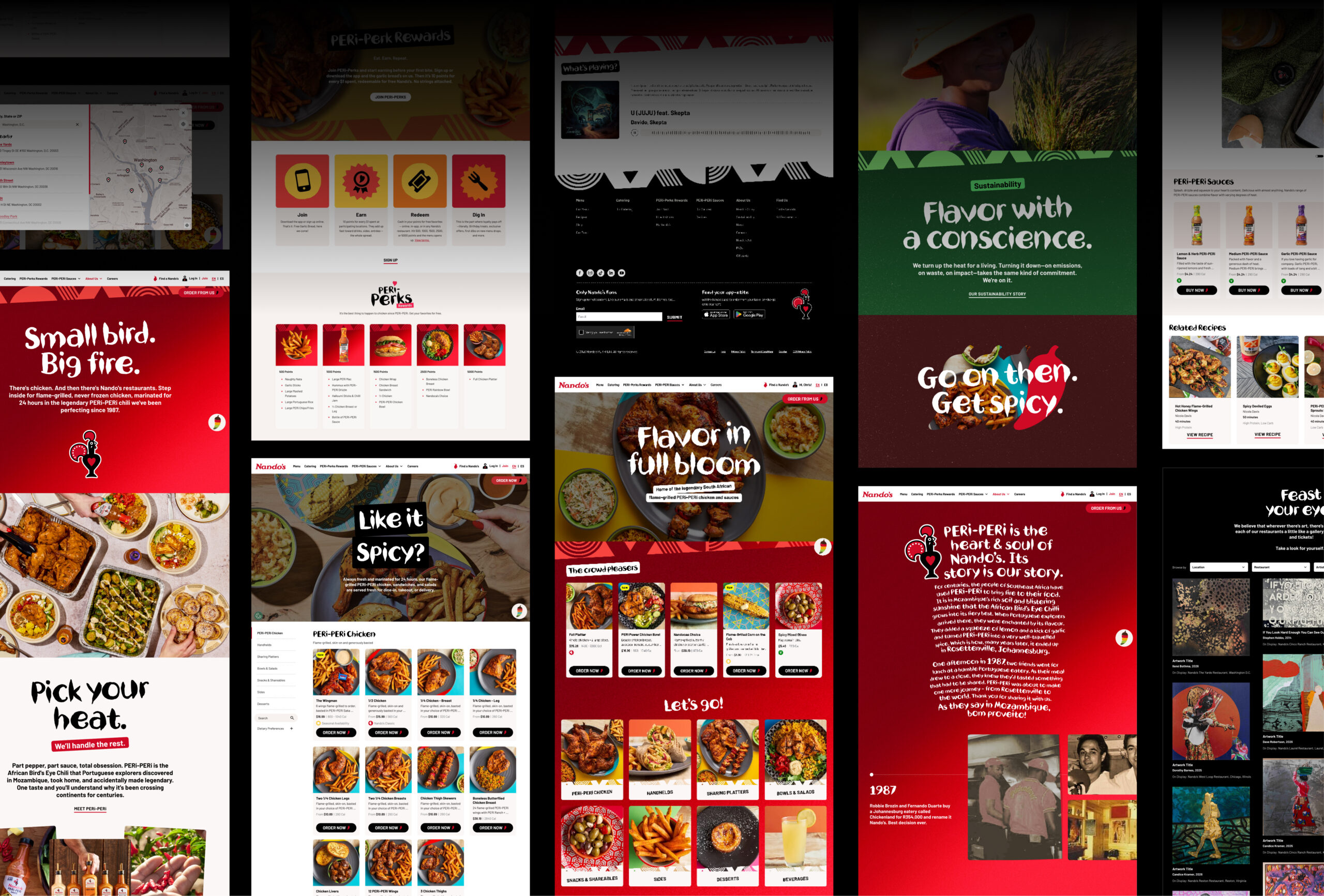
Nando’s PERi-PERi is a global restaurant brand that is still introducing its elf to much of North America. Its websites have three jobs: get guests to order, sign them up for PERi-Perks, and explain what Nando’s is to people who haven’t been yet. We designed and built two new websites, one for the United States and one for Canada, that are built around those three jobs and connected directly to the platforms that run Nando’s ordering, loyalty, and gift cards.
the problem
For a restaurant brand, the website is where most online orders begin, but it isn’t where they finish. Nando’s orders are placed in OLO, a third-party ordering platform. Loyalty runs through Punchh. Gift cards are s old through Pay tronix in the US and Givex in Canada . The brand site sits in front of all of them and has to hand guests off without losing them.
The previous site struggled with that handoff. The menu guests browsed on the website didn’t match the menu they found in OLO, so items and prices could look different between browsing and checkout . Signing in to PERi-Perks dropped guests into a separate s creen that didn’t look like Nando’s. The rewards page loaded blank on some visits, and menu images failed to appear. Location pages, which are often the first page a guest sees after searching for a nearby restaurant , offered little more than a photo and a list of hours.
Behind the scenes, the marketing team was working within a fixed s et of content blocks that rarely fit their
campaigns, and the U S and Canadian businesses were sharing a setup that no longer reflected how either one operated.
The challenge
The hardest part of a restaurant website is the part you don’t control. OLO’s API lets a website read menus, hours, and restaurant status, but it doesn’t let the website build a guest’s cart . Any improvement to ordering had to work within that limit: get guests as close to checkout as possible, then hand them off cleanly.
The data als o had to be live. When a Nando’s closes early for weather or an equipment problem, the change is made in OLO, and the website has to reflect it right away. A guest who drives to a closed restaurant bec aus e the website said it was open is a guest who may not come back.
On top of that , the two markets needed to become two genuinely separate sites. The U S and Canada run on different loyalty and gift card platforms, have different marketing teams and priorities, and follow different laws. Canada requires a fully bilingual French and English site and compliance with CASL and PIPEDA privacy rules. Both sites needed to meet WCAG 2 .1 A A accessibility standards and perform well on mobile, where most guests browse and order.
the solution
An ordering path with fewer steps
We rebuilt the path from menu to order around one idea: the guest’s restaurant should be known before they click order. The site identifies the nearest Nando’s early in the visit , so menus, hours, and order buttons point to a real location from the start.
From there, order buttons deep link into OLO at the right restaurant and menu category, with the order mode (pickup or delivery) passed through. Guests don’t search for their restaurant a second time, and they don’t have to rebuild a cart because an item isn’t available in the mode they picked.
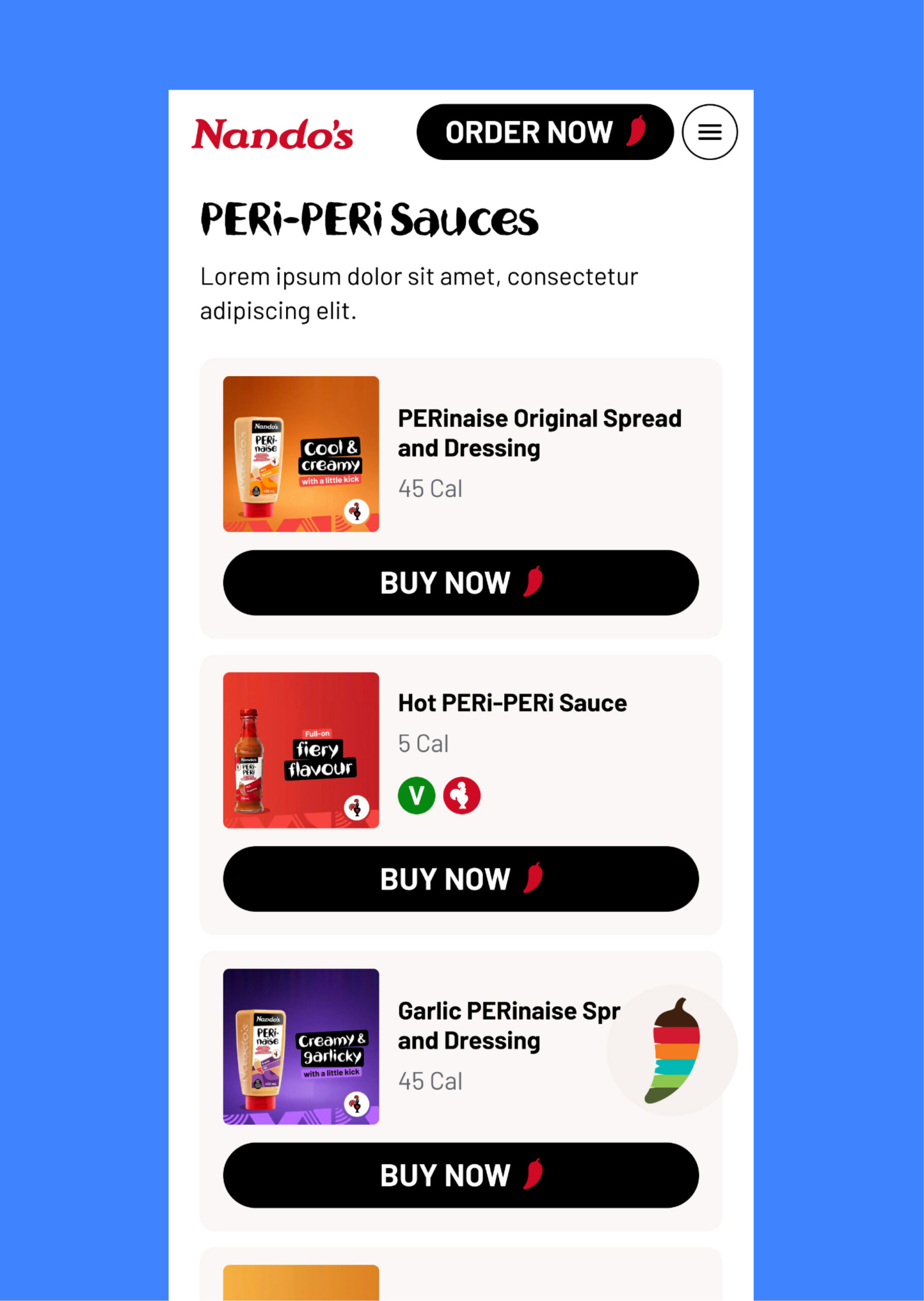
The brand menu and the ordering menu now draw from the same OLO data, so what a guest sees on the website is what they’ll find at checkout. Menu items, prices, images, hours, and open or closed status all come directly from the OLO API. We replaced the old AWS Lambda layer with direct endpoints, so a closure entered in OLO shows on the site right away.
For first-time guests, the site also explains how ordering at Nando’s works: pick your chicken, pick your heat, pick your sides.
PERi-Perks built into the site
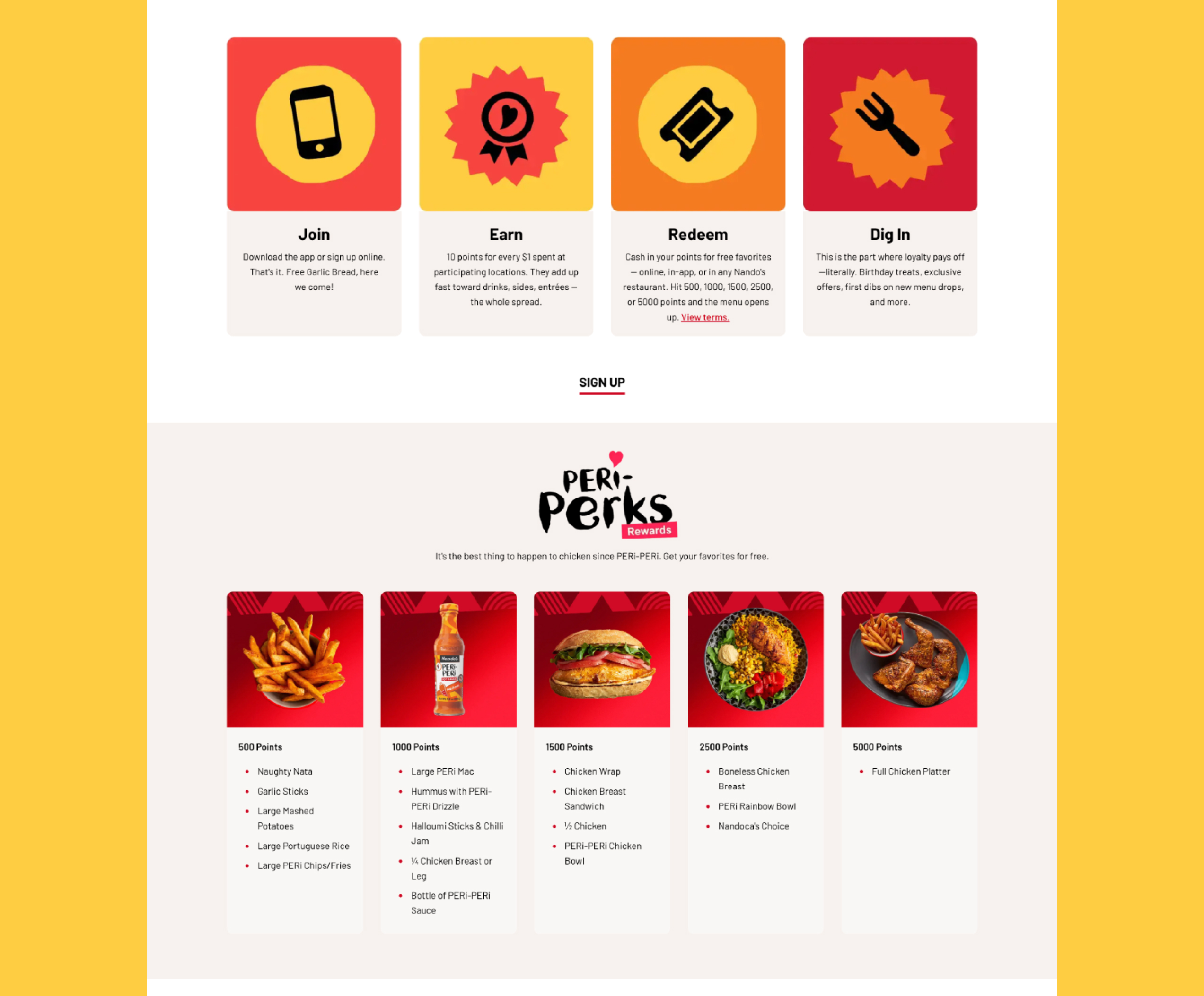
Growing loyalty membership is one of Nando’s top priorities, and the old site kept it out of sight . On the new sites, PERi-Perks is in the main navigation, with sign-up prompts on the homepage, menu, and loc ation pages. The rewards page explains what members get and what points are worth before asking anyone to join.
Sign-up, login, and account access run through Punchh and are styled to match the rest of the site, so joining feels like part of Nando’s rather than a detour. Gift cards connect to Paytronix in the US and Givex in Canada. Two sites on one foundation.
The US and Canadian sites share a component library and codebase, and nothing else. Content, integrations, data, and publishing are separate, so each team runs its own site on its own schedule. When a new component or fix is
built for one market , it can be rolled out to the other without star ting over.
The US site connects to OLO, Punchh, and Paytronix. The Canadian site is fully bilingual, with a French and English toggle on every page, and is built to CASL and PIPEDA requirements, with Givex for loyalty and gift cards.
Location pages that work like homepages
Many guests meet Nando’s through a search for a specific restaurant, so we treated location pages as entry points rather than directory listings. Each one shows live hours and status from OLO, guest reviews from GuestXM, a map and practical details, and an order button that goes straight to that restaurant in OLO. Flexible content areas let the team add more than text and a photo
A CMS the marketing team can actually use
The new Sanity setup gives the Nando’s team flexible content blocks for campaign and landing pages, and any image or block can carry a link or call to action. Scheduled publishing lets menu changes go live on menu day without a morning scramble. Roles, permissions, and a separate workspace for each market keep the two teams from stepping on each other.
Fast, accessible, and findable
Both sites meet WCAG 2 .1 A A accessibility standards and are built for Core Web Vitals and mobile performance. Structured data for restaurants and menus supports both traditional and AI-powered search. Loyalty, gift card, and contact forms are secured, and OneTrust manages consent in both markets.built to CASL and PIPEDA requirements, with Givex for loyalty and gift cards.